 blog
blog
Commercial Painting Contractors Modesto CA: 2026 Guide
Table of Contents
- How to Compare Commercial Painting Contractors in Modesto CA
- Commercial Painting Cost Per Square Foot: What Drives Your Quote
- How to Hire a Commercial Painter: A Step-by-Step Checklist
- Commercial Painting License Requirements California
- Interior and Exterior Painting for Modesto Commercial Properties
- Concrete Floor Coatings, Industrial Painting, and Maintenance Schedules
- Conclusion: Choosing the Right Commercial Painting Contractor
- Frequently Asked Questions
Last Updated: September 16, 2026
How to Compare Commercial Painting Contractors in Modesto CA
Choosing the wrong commercial painting contractor costs more than money. It costs downtime, tenant patience, and a second round of mobilization when the first crew's work fails. This guide from California Crews covers exactly how to compare commercial painting contractors Modesto CA property owners can rely on, from licensing checks to quote analysis.
The stakes are higher than most facility managers expect. A repaint that disrupts operations or fails within two seasons forces you to repeat the entire process, often at double the original cost. The comparison process below is built to prevent that outcome.
Licensing, Insurance, and CSLB Verification
Every legitimate painting contractor in California holds a license through the Contractors State License Board. The CSLB maintains a public database where you can verify license status, classification, bond, and complaint history in minutes.
The C-33 classification covers painting and decorating. A contractor without it cannot legally bid on most commercial work. Check three things: active license status, current workers' compensation coverage, and general liability limits that match your property value.
Ask for certificates directly from the insurer, not from the contractor. A common mistake is accepting a photocopy that expired months ago.
Local Experience and Material Sourcing
Central Valley heat and sun punish exterior coatings. A contractor who works primarily in coastal climates will specify products that chalk and fade here within two summers. Local experience means knowing which industrial-grade paint systems hold up to 100-degree afternoons and valley dust.
Ask how they source materials.
Commercial Painting Cost Per Square Foot: What Drives Your Quote
Commercial painting cost per square foot varies widely because no two buildings present the same conditions. Square footage is only the starting number. The real drivers are surface condition, access difficulty, coating system, and prep work.
| Cost Driver | Impact on Quote | What to Ask |
|---|---|---|
| Surface condition | Higher prep time | How many hours of substrate repair are included? |
| Building height | Equipment and safety costs | Is lift rental itemized separately? |
| Coating system | Material cost per gallon | Which product spec and how many coats? |
| Occupancy | After-hours scheduling | Is night work billed at a premium rate? |
| Square footage | Base measurement | Is the measurement field-verified or estimated? |
| Coating type | Epoxy and industrial systems cost more than standard latex | Is the floor or steel spec priced separately from wall paint? |
A Rough Price-Per-Square-Foot Guide
Use these ranges as a sanity check on bids, not as a substitute for a site walk. Actual numbers depend on your building, your market, and the coating system specified.
- Interior repaint, standard commercial space: roughly $1 to $3 per square foot of paintable wall area, including basic prep and two coats.
- Exterior repaint, stucco or block: roughly $1.50 to $4 per square foot, higher with heavy prep or multi-story access.
- Concrete floor coatings (epoxy or similar): roughly $3 to $8 per square foot, driven by surface prep, moisture testing, and system thickness.
- Industrial and structural steel coatings: priced per project, often by linear foot or by steel surface area, because spec and access dominate cost.
How to Request a Free Estimate and Read It
A free estimate should include a site assessment, a written scope of work, product specifications, and a payment schedule. If any of those four items is missing, the quote is incomplete.
What Separates a Low Bid From a High Bid
When two bids for the same building differ by 40 percent, the gap almost always lives in one of four places: prep hours, coating brand and grade, number of coats, and access equipment. Ask each bidder to state those four items in writing. Once they are side by side, the cheaper bid usually stops looking cheaper.
How to Hire a Commercial Painter: A Step-by-Step Checklist
Hiring a commercial painter follows a predictable sequence. Skipping steps is how property managers end up with unbudgeted change orders and unfinished punch lists.
Use this checklist for every bid you evaluate:
- Verify the C-33 license and insurance certificates directly with the issuer
- Confirm at least three comparable commercial projects completed locally
- Request a written scope that names products, coats, and prep steps
- Walk the site with the estimator and note what they inspect
- Compare exclusions across all bids, not just totals
- Confirm the payment schedule ties to milestones, not calendar dates
- Get the workmanship warranty in writing with its duration
- Ask who supervises the crew and who your daily contact is
Questions to Ask Before You Sign
The answers reveal more than the bid sheet. Ask how they handle tenant complaints during the project, what happens if weather delays exterior work, and whether the same crew finishes what it starts.
Commercial Painting License Requirements California
Commercial painting license requirements in California center on one thing: the C-33 Painting and Decorating classification issued by the CSLB. Any project over $500 in labor and materials requires a licensed contractor.
What the CSLB Requires of Painting Contractors
The CSLB requires contractors to pass a trade exam, carry a surety bond, maintain workers' compensation coverage, and renew licenses on a fixed cycle. You can verify all of this through the CSLB license lookup and consumer resources.
Interior and Exterior Painting for Modesto Commercial Properties
Interior and exterior painting demand different product systems, different prep, and different scheduling. Treating them as one line item is a common estimating shortcut that leads to premature failure.
Surface Preparation and Durable Coatings for High-Traffic Areas
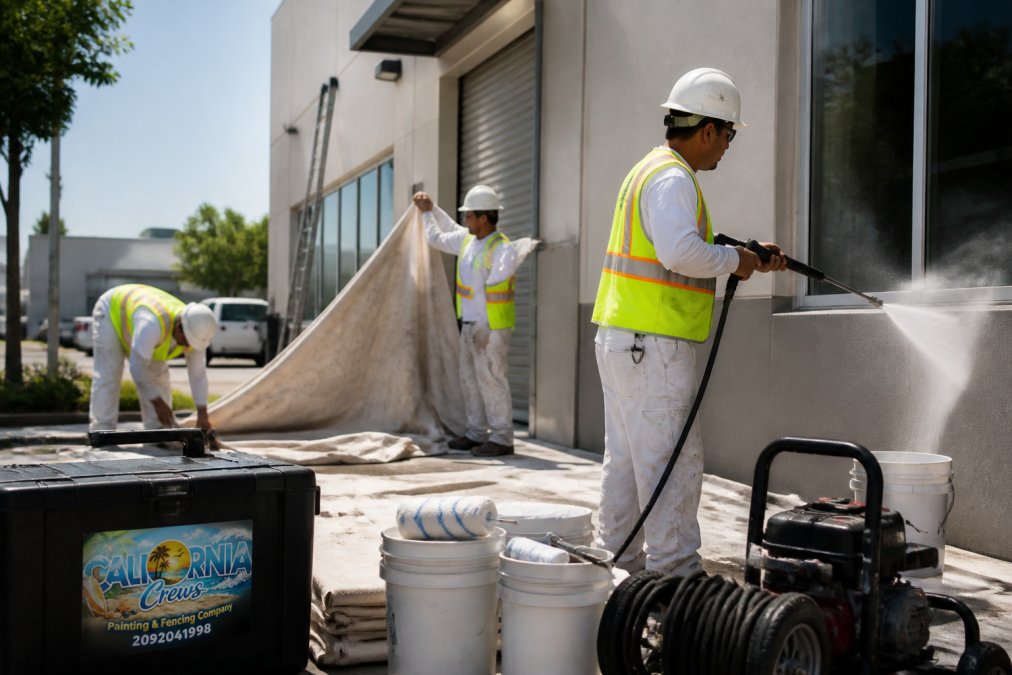
Surface preparation determines how long the finish lasts. Power washing, substrate repair, patching, and sanding are not optional steps; they are the foundation the coating bonds to.
Concrete Floor Coatings, Industrial Painting, and Maintenance Schedules
Concrete floor coatings and industrial coatings protect surfaces that paint alone cannot. Epoxy flooring and similar systems resist chemical spills, forklift traffic, and constant cleaning in ways standard paint does not. The key is surface prep: concrete must be profiled, moisture-tested, and often patched before any coating goes down, or the system delaminates within a year.
Commercial Maintenance Schedules: How Often to Repaint
A maintenance schedule beats reactive repair every time. Most commercial properties need a walkthrough each year to catch chalking, cracking, and rust before they spread. The cadence below reflects common practice for commercial buildings in a hot, dry climate with strong sun exposure.
| Maintenance Task | Frequency | Best Season |
|---|---|---|
| Exterior walkthrough and touch-up list | Annually | Spring |
| Power washing and inspection | Annually | Spring |
| Interior high-traffic repaint | Every 2-3 years | Off-peak |
| Concrete coating inspection | Annually | Fall |
| Rust and substrate check | Annually | Fall |
| Full exterior repaint | Every 5-7 years | Spring or fall |
| Full interior repaint | Every 5-8 years | Off-peak |
Eco-Friendly Coatings and Compliance Considerations
Low-VOC and zero-VOC coatings matter more on occupied commercial properties, where fumes affect tenants and staff. Many product lines now meet strict VOC limits without sacrificing durability. For occupied spaces, specify low-odor, low-VOC products and schedule work during off-hours to keep air quality acceptable.
Conclusion: Choosing the Right Commercial Painting Contractor
The right contractor makes commercial painting predictable: clear scope, verified license, honest exclusions, and a warranty that means something. The wrong one turns a repaint into a renovation.
Frequently Asked Questions
How much does commercial painting cost per square foot in Modesto?
Commercial painting cost per square foot in Modesto depends on surface condition, prep work, coating type, and building height. Interior repaints on smooth drywall typically cost less per square foot than exterior stucco that needs power washing and substrate repair. Industrial-grade paint and epoxy flooring add to the total. Request a free on-site estimate from a licensed contractor for an accurate number.
Do commercial painting contractors in California need a CSLB license?
Yes. Any project over $500 in labor and materials requires a California State License Board (CSLB) license. Commercial painting falls under the C-33 Painting and Decorating classification. Ask for the license number and verify it on the CSLB website. A licensed contractor also carries workers' compensation and liability insurance, which protects your property if an accident happens on site.
How do I hire a commercial painter without getting surprise charges?
Get a written, itemized estimate that lists labor, materials, surface preparation, power washing, and cleanup. Ask if the quote includes paint and primer costs, and confirm the payment schedule. A reputable contractor will not ask for full payment upfront. Check that the scope covers high-traffic areas and any substrate repair. Compare at least two or three estimates before signing.
What should a commercial painting maintenance schedule include?
A maintenance schedule should cover annual inspections of exterior coatings, touch-ups for scuffs in high-traffic areas, power washing before repainting, and re-coating timelines based on coating durability. Facilities with concrete floor coatings or epoxy flooring need periodic re-sealing. Scheduling repaints before small issues become large repairs keeps commercial property maintenance costs predictable.